In Little Amélie, memory becomes both a refuge and a prism—reshaping the world through the vivid imagination of a child. The film’s directors explore how animation can capture emotions, sensations, and recollections in ways live-action often cannot, blending visual poetry with emotional truth. In this exclusive interview, they reflect on the unique expressive power of animation, the challenges and freedoms of depicting childhood on screen, and the creative choices that bring Amélie’s inner world to life...
The watercolor aesthetics and the way the characters’ emotional bonds intertwine are incredibly striking. Especially in the scenes where Amélie and Nishio embrace, their lines blend together… How did you envision this, and how did you bring this feeling to life during the storyboard stage?
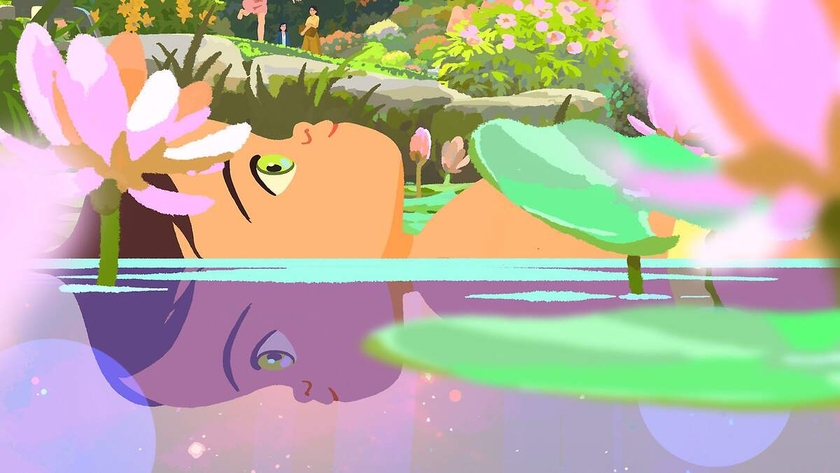
Mailys Vallade: For many years now, we have enjoyed working with this graphic style, which has no outlines and is simplified by the use of color blocks or flat areas of color, in a rather impressionistic way, often very close to the characters. It is the sensual aspect and the fact that there are no boundaries between the shapes of colors, between characters and backgrounds, as well as the light that shines on the whole, which for us forms a very sensual, connected whole. With our artistic director and co-screenwriter Edine Noël, we had a few painters as references—Joaquin Sorolla, Henri Rivière, Hasui Kawase, Sydney Smith, for example—and many others.
In this film, we pushed the “sensory” rendering to a child’s level, adding “camera focus” blurring to create a sense of distance or proximity. It was especially the proximity between the characters and the things Amélie discovers that was important to us, in order to connect with her emotions. Our “graphic family” was formed on our previous films (Long Way North and Calamity by Rémi Chayé). Personally, I have been working this way since my student films, which is one of the reasons why Rémi Chayé wanted to work with me at the time. This rendering was designed as a team with our other graphic co-authors—Marietta Ren, Marion Roussel, Justine Thibault, Simon Dumonceau, and Rémi Chayé—to whom we owe an obvious legacy of the method. We work in digital painting on Adobe Animate and Photoshop for the backgrounds.
Color obviously plays an essential role in the film’s narrative and greatly contributes to the atmosphere of the scenes. The colors were chosen to reflect Amélie’s emotions as she experiences the seasons throughout the year, led by Justine Thibault and Simon Dumonceau. The painters on the team conducted research using watercolors and gouache. The compositing work was also very important for this rendering, with contour effects reminiscent of chalk or a slightly dry brush and accompanying special effects, such as the lighting and water effects sought by our compositing supervisor Tevy Dubray.
Liane-Cho Han: I believe that everything has already been said by Maïlys. As she said, we also have this legacy from Rémi Chayé’s movie. In France, we are very rich in all these different beautiful animated movies, but we almost have to reinvent the wheel every time a new project is being made. We don’t have those major studios like in the US or even in Japan, where the same people collaborate for many years in the same style that evolves over the different projects. Here, we were able to work with this same amazing artistic and production team that has known the style for many years, so we could focus more on the narration and emotion. That same style—evolving depending on what the movie demands in terms of story and tone, yet still building from the same root—made us more efficient as well.
Amélie is a child growing up in both Belgium and Japan. While portraying her experience between these two cultures, which visual or symbolic details did you consciously emphasize?
Maïlys: This story takes place in Japan in the late 1960s, and Amélie comes from a family of Belgian expatriates; her father is the consul at the Belgian embassy at that time. So the first major challenge was to render this period as accurately as possible. Particular attention was paid to the traditional Japanese house, which plays a key role in the film, as most of the scenes take place there and the lighting in it is also very important for the scenes. Eddine Noël therefore undertook extensive research to reconstruct a traditional house typical of the period, but furnished with Western objects. Particular care was taken to ensure that every object in the scenes existed at that time. The same was true for the garden.
The second major challenge was the themes we were going to focus on, and for this, our team of graphic authors carried out a concept stage that we could use to support the most important themes related to Japan:
● the bubble: it expresses this god who is not a creator but the opposite, inert and cut off from the ordinary world, symbolizing a form of Zen.
● The Yokaï/reading: This is the first appearance inspired by her first real connection with the young Japanese girl Nishio san. We wanted to give her the power to capture Amélie’s full attention through reading (a nod to the original writer) and this Japanese spiritual being, directly linked to the “protection of the gods.” everything is done to appeal to the little heroine.
● The Litchis spinning tops: They symbolize the two soul mates, Nishio san and Amélie, as if they were gravitating around each other.
● The carp and koinobori (flags) symbolize boys (at that time) formerly known as “Tango no sekku,” but now called “kodomo no hi” for all children.
● Death/Obon: One of the most important themes we chose to focus on in our adaptation is death and mourning. To do this, we needed to find something, an altar or a celebration, that would offer Amélie a positive way to mourn, to overcome loss and absence. The Obon festival was the perfect date for the film.
● The pebble river and Kashima san’s secluded house: we wanted Kashima san, who represents negative grief and withdrawal, to live in a secluded, very traditional place. The famous dry gardens of Japan were ideal for representing the character and accentuating the “invasive” effect when Amélie enters her sacred territory.
LC : Everything has been already mentioned here. I just would like to add the character of rain, AME which means rain in japanese. It’s also a strong symbol that connects Amélie to Japan through Nishio san when she teaches her how to write it. It was very anecdotique in the book but we wanted to emphasize it more as it also really illustrates Amélie’s identity and how she defines herself through both cultures. It also has this strong impact as it is the character of rain that will bring her back to life at the end, to this memory with Nishio san. To remind her that she’s not from either or, but from both cultures.
Amélie’s perspective is simple yet deeply affecting. Did you rely on real child observation, your own memories, or a completely stylized emotional world to create this viewpoint?
Maïlys: It was very difficult to determine this perspective, which may seem simple when you watch the finished film. But in terms of narrative construction, it was the biggest challenge we faced. Not only in terms of the visuals, but even more so in terms of the entire structure of the story and Amélie’s narrative voice, which literally structured the film. First, we had to understand that we weren’t going to make Amélie a character with creative superpowers, but that we were going to be in her perception, throughout the entire film, and therefore we would be able to move from a surreal scene to a very realistic one without any problem, since we were allowed to do anything. But everything had to be in exact relation to her emotion at that moment. The beginning is her arrival in the world, her gaze does not yet read everything, everything is overexposed, then when she takes possession of her body, when she controls her movements, then everything becomes possible. The scale of the elements can change according to her imagination, as well as the way the scenes are staged. Amélie’s unique gaze and the child’s eye view in the staging are cinematic choices that allowed us to adjust the narrative and make it accessible to children and adults alike. We all drew on our memories and feelings from our early childhood, when our attention was focused on an insect, a glance, or a vexation along the way.
Of course, there is also the observation of our own children. I have three children and little twin girls who were Amélie’s age when we were making the film. I spent a lot of time glued to their eyes, very close to them, and a 2-year-old is very chaotic. And it must be said that Amélie is a very mature child for her age, very unique in that respect, so putting myself in her shoes was a very perilous and unusual balancing act.
LC : Of course our own kids are an amazing inspiration source. You follow their evolution through the years and it’s so fascinating. I remember when my son was born 8 years ago, and he was a very difficult baby. Here I realized that not only Amélie believed she was god, every children believe they are gods. Even though Amélie is very singular in her personality but also in the set she was living, every kids go through this step from early childhood to childhood. When they believe they are at the center of the universe until they realize that they are not, they are part of it. And somehow, that’s what Amélie experiments. We have built this disillusion at the end but also to say that’s ok to not be god, as she then start to open and to connect herself to her family and the world. And of course we used our own memory which is more blurry but more based on sensation. I remember my parents arguing and yelling at each other when I was small, and even though I couldn’t understand the subject, I could feel the tension that affected me. Just like Amélie when Nishio san and Kashima san are arguing at the end. We also all remember when parents are driving kids back home after a big day, with the sun coming down and the kids sleeping, listening or observing the rain drops falling on the car. All those feelings contributed in the story telling.
Amélie’s “becoming human” process in the film is both a physical and emotional awakening. How did you concretely express this through animation (colors, line transitions, or scene rhythm) and what approach did you take?
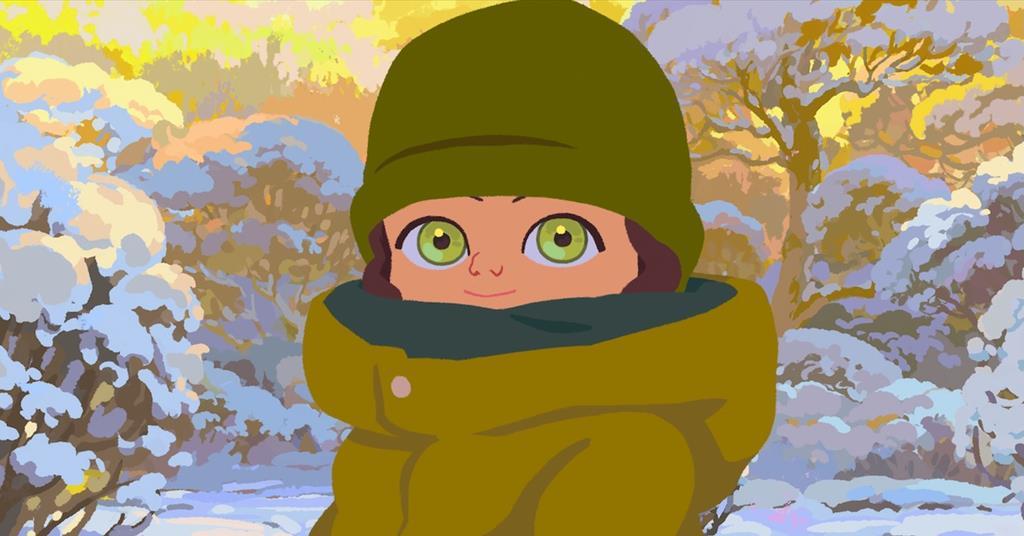
Maïlys: I would say that we mainly tried to be as “sensory” as possible, meaning that we had to make everything feel amplified compared to reality, Amélie’s sensations being rather “extraordinary” and “exponential,” since her evolution is very sudden, she goes from total immobility to chaotic movement, then from chaotic movement and ‘normal’ physical evolution to sudden “self-awareness” (with the white chocolate). These rapid developments were therefore really conducive to developing a staging that moves from the microscopic to the gigantic, from immobility to full speed, and then adopting points of view and elements that reinforce these rapid developments: for example, for the dizziness of her first awakening, the shock wave caused by the tiny speck of dust ultimately awakens a giant, so the body weighs a weight she never knew before she found herself standing up, so the slowed-down, heavy movements and slightly heavy colors contributed to this understanding. The editing and the elliptical choices of representation also reinforce all these aspects: the pilgrims who come to see her, the timelapse, the entire temporality in the film is designed to expand with the rhythm of the editing, accelerating or decelerating in the same way as a piece of music, and the music composed by Mari Fukuhara played a major symbolic role, with each choice of instrument accompanying and punctuating each theme and each upheaval in a very precise manner.
LC : Indeed like Maïlys said, everything is through sensation and perception. Like what has been said previously, color, scale and definition of details are also part of her evolution to “become human”. The way the garden seems unlimited until it starts to have borders. Or when the colors shine less and lose saturation to become more “realistic”. But also physically as Amélie is in this particular stage between a baby and a child. We can see for example that her neck starts to be longer at the end of the movie, a physical sign that she’s not a toddler or “god” anymore.
The theme of memory and childhood creates a nostalgic yet thought-provoking tone in the film. In your opinion, what advantages does animation have in conveying memories and childhood experiences compared to live-action or traditional cinema?
Maïlys: Drawing and painting can amplify sensations. Artists translate reality through their gaze, interpreting it in a way that synthesizes and even exaggerates things we don’t pay attention to amid a profusion of details and overly realistic situations. Reality is very important; that’s where we start in our approach. In fact, certain very realistic scenes, such as a drop on a window, become iconic and extraordinary through the synthesis of their form. Animation is a wonderful tool for bringing metaphors and distortions of reality to life. Our means of expression carries with it this ability to immediately take a step back, and when we then manage to juggle the elements and symbols, I think we can create “super-connections.” In our story, there is this child’s gaze, and this graphic rendering is rather naive in its overall form and highly acidic colors. This naivety contributes completely to understanding and empathizing with Amélie’s feelings. The imaginative power of a child is difficult to reproduce, so I find it very touching, this attempt to access our deepest memories, very personal resources, in the elaboration and consistency of the slightest movement and the slightest element looked at.
LC : Pretty much everything has been said here. It’s always this eternal question, why animation and not live action. I would also say that having a real 2,5 year old actress that plays the way we wanted would be pretty hard to find. Would the parents of this actress allow us to let their 2,5 year old kid drown in the sea or jump and do saltos on trampolines which will be flowers in CG? For some reason, animation also offers some kind of control in the way we would like the characters to perform. It also offers a consistency in the general imagery compared to if we have to do some effects in CG with real actors. And I’m pretty sure that it would also be much more expensive to make in live action too. Reproducing a whole Japanese house in a studio for example. The most important thing is that the audience connects with the characters and it’s for us the best compliment when people say that they forgot that they have watched an animated movie. They have watched real cinema.
Portraying intense emotions such as loss and belonging through a small character must be challenging. What were the biggest difficulties in this process, and how did you overcome them?
Maïlys: The biggest challenge was the writing, managing to address heavy themes such as death and grief through the relationship between Amélie and Nishio san in post-war Japan, and making it accessible to all viewers, young and old, with multiple levels of interpretation. We had to take the connection between Amélie and Nishio-san to its maximum potential. It was really a matter of stretching an invisible elastic band, like drawing a bow before releasing the arrow that breaks it. To do this, we had to completely rethink the character of Kashima-san, give her a more concrete past than in the original book, and connect her to Nishio-san, in a relationship where Kashima-san is dominant and Nishio-san is a servant. Kashima san is a former aristocrat who fell from grace during the war 30 years earlier, and the balance between the terrible stories experienced by the two women is the keystone that causes the collateral damage that little Amélie will experience throughout the story.
Ultimately, it is a triangle, or even a quartet of women in this film, that leads us to grasp this feeling of loss and find the positive keys to escape from this absolutely abstract and dizzying situation. The grandmother, Nishio-san, and Kashima-san are very important figures for Amélie, helping us to understand what strikes Amélie when she loses everything she thinks she has at the moment she realizes she is going to lose everything that was dear to her until then. Once the arc of these characters’ appearances and disappearances was well coordinated and balanced, it became possible to reach the climax and the keys to understanding the whole for Amélie.
The philosophical and very mature perspective of the narrative voice was also one of the biggest challenges of the film, and we had to rewrite it until the end of post-production. This meant that we had to record the voice actors after animating my test voices and those of our editor Ludovic Versace. As I said earlier, this narrative voice structures the overall story, and the place from which it speaks to us was also important: it is the Amélie at the end of the film who speaks to us, not beyond. The balance between her excessive presence, which could make her unbearable, and her excessive absence, which would make the story too sad and empty, was crucial. Finding the right balance and accuracy in the scene where the two Japanese women confront each other, comparing their experiences with different generational and social backgrounds, was the most challenging part for us.
And above all, to transform the outcome of this story, which in the original book is not so positive, into something that leaves a positive message and ending. We wanted to address empathy in this film, and if we could convey the feeling of loss of bearings and uprootedness through this little girl of Belgian origin, through her love for Nishio-san, her story, and Japan, then we would have achieved our goal. Amélie lives in an ideal world, and we had to make it clear that the ideal is not necessarily the truth, that things are not necessarily as we imagine them to be, but that’s okay, we must have the humility to question them, and accept that things may escape us, because there is always something else behind them, and it can be just as good, or even better!
LC : Everything has been perfectly well said here. I don’t have much to add. It was indeed a very difficult journey. The original book was not written for kids and it deals with very heavy subjects. But with Maïlys we always wanted to do an inter-generational movie that could talk to the younger and the older. And in this world, everyone has a strong opinion about what a kid can handle or understand. With Maïlys we believe that a kid can understand more than we think, they just understand in a different way. So we decided to just trust them. They will of course ask questions, but it’s a good thing. We also as adults or parents shouldn’t avoid answering them because we believe they are too young to understand. We just need to find the right angle. Like when Nishio san talks about war and her story through cooking.
The same goes with the concept of God. Everyone has a strong opinion about what God is. We decided to minimize it as much as possible as we wanted to focus more on Amélie and her relationship with Nishio san, and leave the concept of “God” and “Not God” more like a symbol about being closed or open to the world. Using the disillusion and the concept of memory as transitions from one stage to another.
 bifilmkurdu.com
Yorum yazabilmek için oturum açmalısınız.